
Tree
Peak · Late winter – spring (Feb–May)
The first wave of the season - oak, birch, cedar, maple, ash. Warm, dry, breezy days send counts soaring; a single oak can release millions of grains.
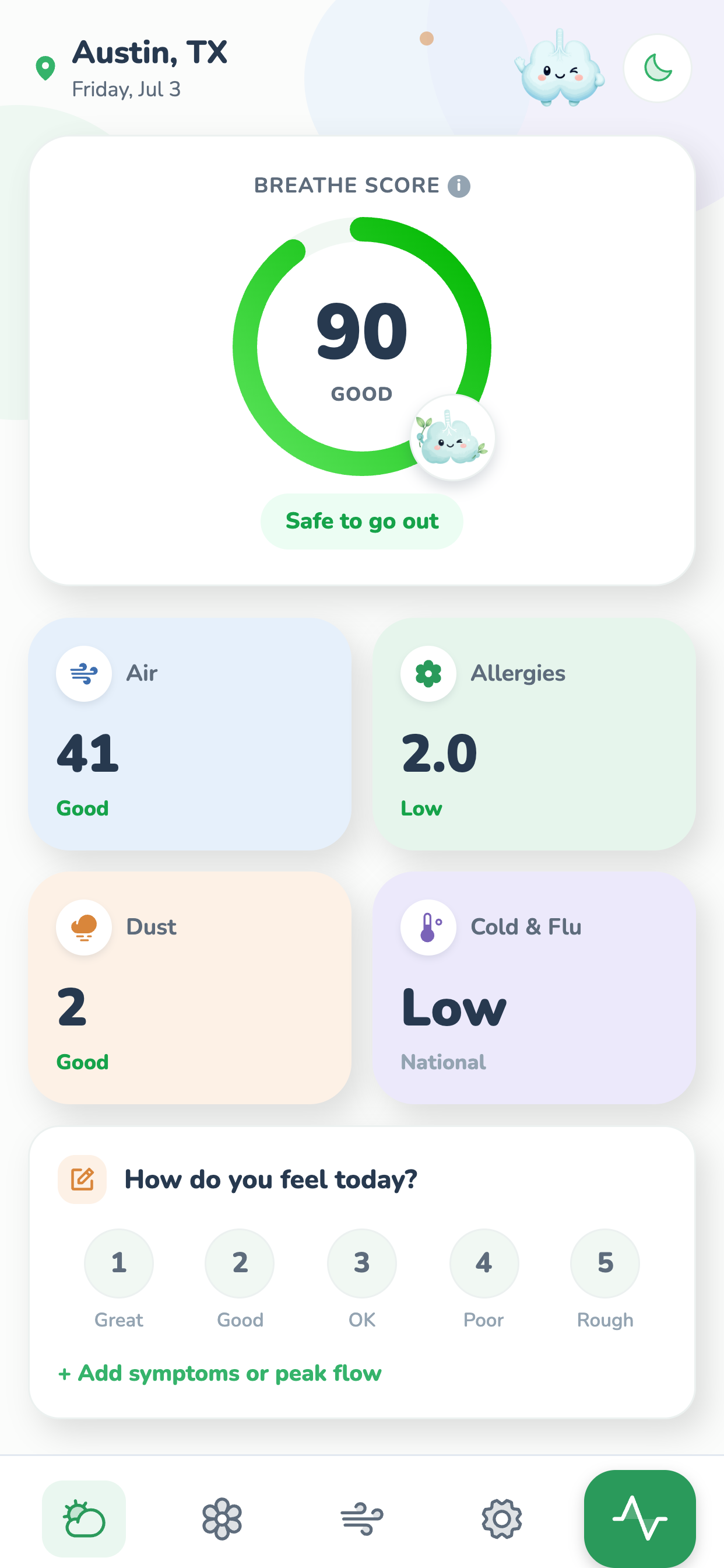
Today's tree, grass, and ragweed pollen and the US air quality index for your area - rolled into one personal Breathe Score, with a plain read on whether conditions look favorable.
Austin, TX
Today · Sample data (preview)
Individual responses vary. Consider your symptoms, asthma action plan, medications, and healthcare professional's advice.
The Breathe Score is a general wellness feature and has not been medically validated. It does not predict symptoms, asthma attacks, infection risk, or whether it is safe for you to go outside. Follow your asthma action plan and your healthcare professional's advice.
Do not use SafeInhale to decide whether to seek urgent medical care. Follow your asthma action plan. If you are very short of breath, cannot walk or talk normally, your lips or fingernails appear blue, pale, or gray, or your quick-relief medicine is not helping, call 911 or your local emergency number.
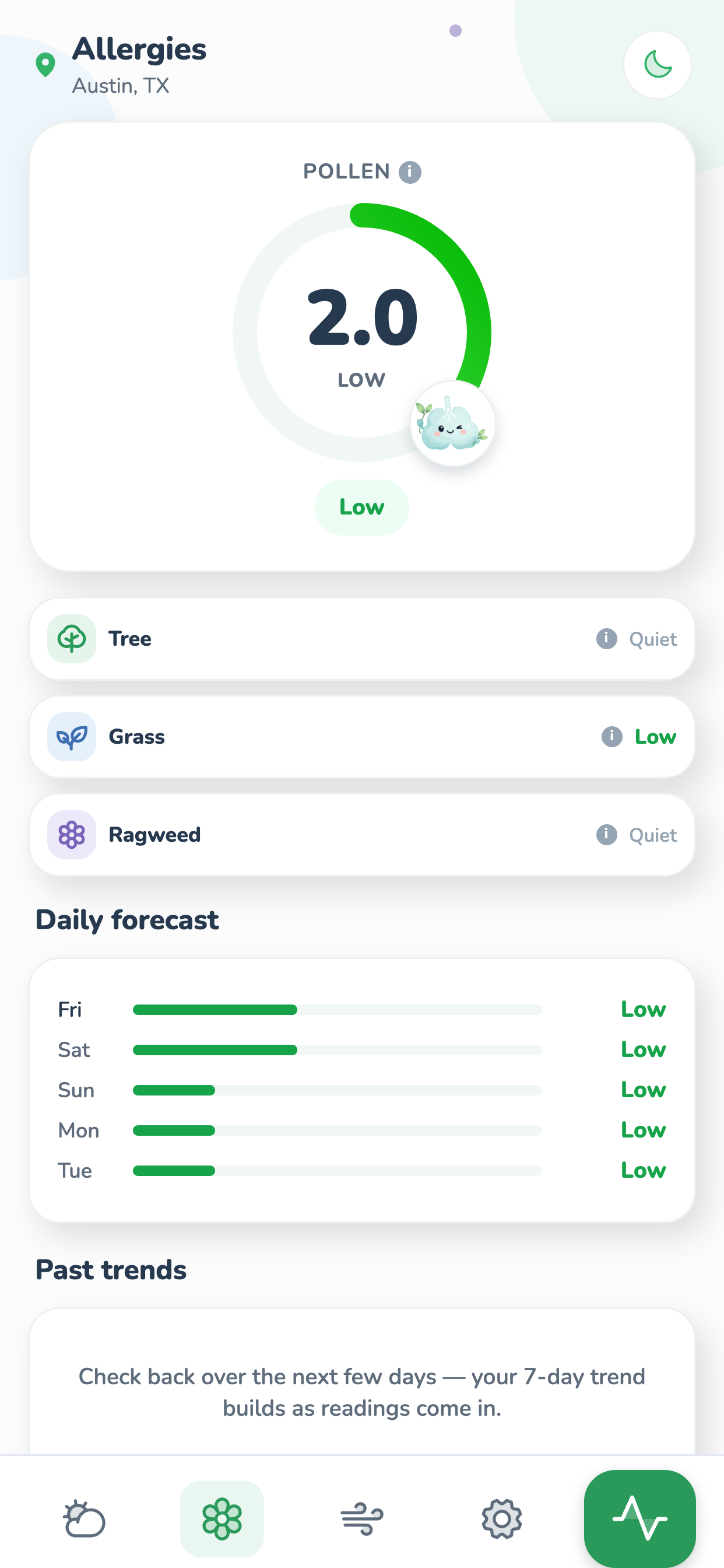
The three drivers of US seasonal allergies for Austin, TX.
Pollen forecast data is provided by Google, and values are modeled forecasts rather than live measurements at your exact location, so actual exposure can vary with weather, vegetation, and local conditions.
Overall pollen by day for Austin, TX - plan errands, runs, and open windows around it.
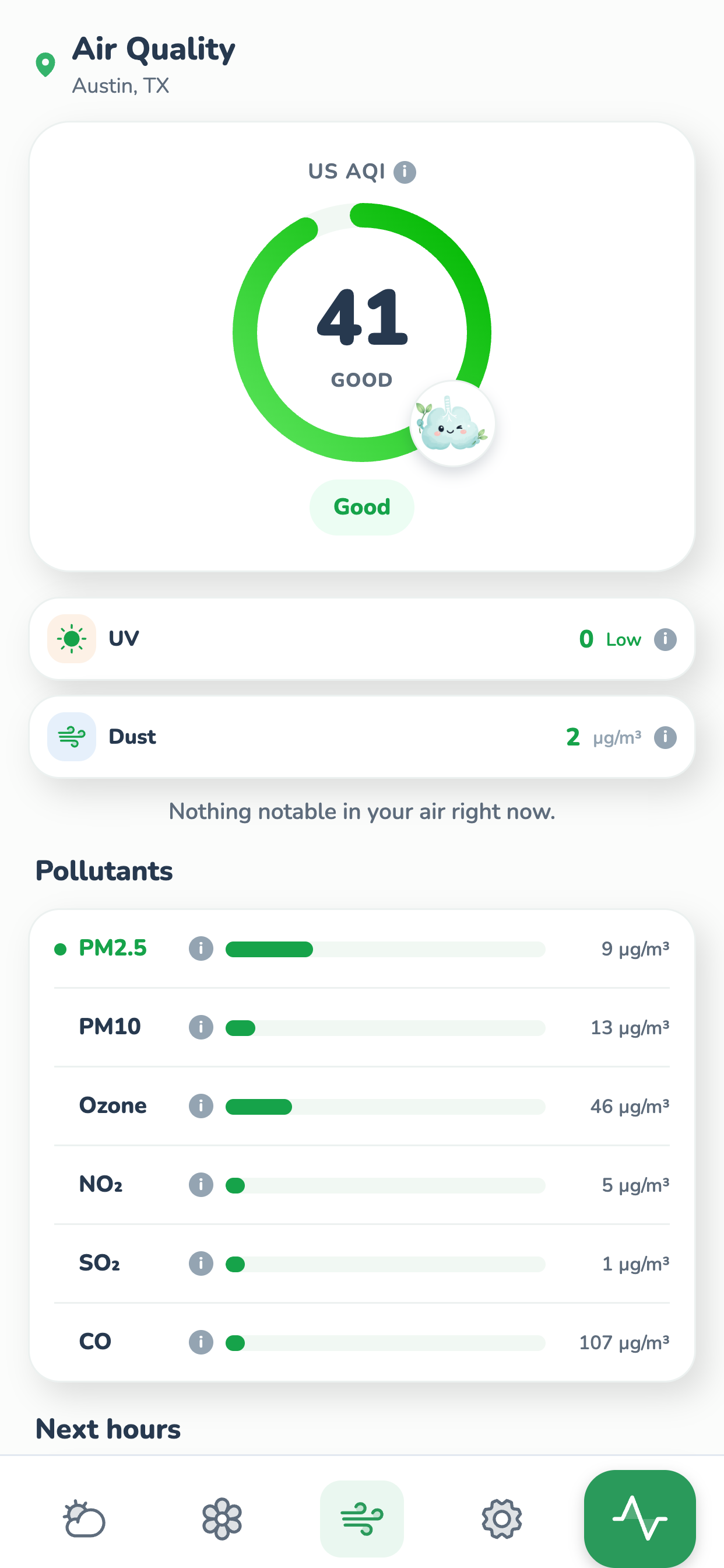
Each metric uses its own scale - consistent colors make the results easier to understand.
Typical US peak windows. Your local timing shifts with climate and weather.
Tree, grass, and ragweed - what's in the air and when it tends to flare.
Peak · Late winter – spring (Feb–May)
The first wave of the season - oak, birch, cedar, maple, ash. Warm, dry, breezy days send counts soaring; a single oak can release millions of grains.
Peak · Late spring – summer (May–Jul)
The most common allergy trigger worldwide. Mowing and warm afternoons spike exposure; counts often peak mid-morning and early evening.
Peak · Late summer – fall (Aug–Oct)
The classic cause of fall hay fever. One plant can release up to a billion grains a season, and they travel for hundreds of miles on the wind.
Your Breathe Score and daily verdict tell you, in one glance, whether conditions look favorable for being outside - before you commit to that run or errand.
When pollen or AQI is high, keep windows shut and run AC on recirculate. Pollen pours in through open windows in the early morning.
Pollen clings to hair and skin. An evening shower keeps it off your pillow so you breathe easier overnight.
SafeInhale includes guided breathing exercises (pursed-lip, diaphragmatic, box) for calmer, easier breathing on stuffy days. General wellness - not medical treatment.
One 0–100 number that combines air quality, tree/grass/ragweed pollen, weather, and national flu activity into a single, personalized read - with a plain verdict on whether conditions look favorable. It bends to your profile: if ragweed is your trigger, a windy ragweed day warns you even when the generic level is "Low."
Tree, grass, and ragweed - the three drivers of seasonal allergies in the US - for today plus a 5-day forecast, with day-by-day trends. Levels follow the same Low / Moderate / High / Very High bands the major pollen sources use.
SafeInhale displays a U.S.-style AQI estimate calculated from modeled pollutant information (PM2.5, PM10, ozone, NO₂, SO₂, and CO) using EPA AQI breakpoint categories. It may differ from readings reported by nearby AirNow monitoring stations. The color categories follow the EPA scale - Good through Very Unhealthy / Hazardous.
No. SafeInhale is an informational tool that surfaces public environmental data and a personalized read on it - you check and decide. It is not a medical device and makes no diagnosis or treatment promises. The breathing exercises are general wellness, not medical advice.
Air quality and weather from Open-Meteo (the CAMS model), with current temperature and humidity from the U.S. National Weather Service; pollen from the Google Pollen API, with Pollen.com (IQVIA) as a fallback; and flu activity from the U.S. CDC's ILINet (FluView), via Carnegie Mellon's Delphi Epidata API. When a location is missing data for one component, SafeInhale says so rather than showing a falsely-good score.
Yes - current conditions, the daily verdict, the forecast, breathing exercises, the journal, and saved locations are free. Available in English, Spanish, French, and Portuguese, with a dark mode. United States to start (pollen coverage and the AQI standard are US-centric). No account, no ads, no tracking.
Join people who want a clearer daily read on their air.